
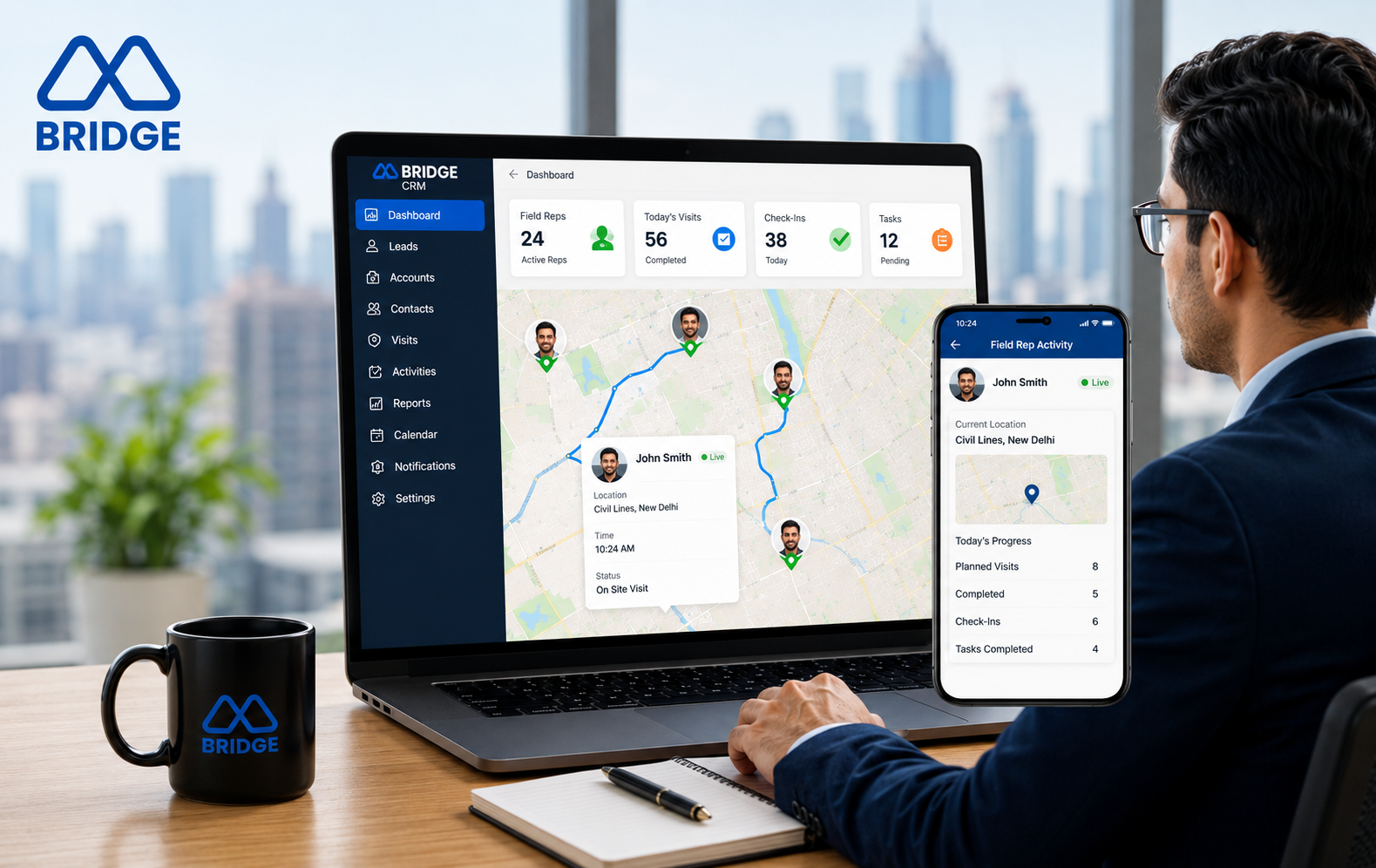
Bridge CRM helps managers track field reps in real time through Bridge FieldOps, its native field force management module. It captures every dealer visit with GPS verification, records structured visit reports on the rep’s mobile app, tracks beat plan adherence, and surfaces all of this in a live manager dashboard without any manual reporting.
Here is the reality no one talks about.
Your reps cover large territories. Some of them are visiting 8 to 12 dealers a day across districts and states. You have no way to confirm whether those visits actually happened, what was discussed, whether any commitments were made, or what the dealer’s actual stock situation looks like. By the time a daily call report reaches you, it is already twelve hours old and edited for comfort rather than accuracy.
Multiply that across 30, 50, or 100 field reps spread across India, and the visibility problem becomes a revenue problem. Deals stall because nobody followed up. Dealers go quiet because a competitor’s rep showed up and yours did not. Stock runs out at a key outlet while a manager sits in an office looking at a dashboard that says everything is on track.
This is the problem Bridge CRM and Bridge FieldOps are built to solve. Not by adding more reporting requirements for field reps, but by capturing what actually happens in the field automatically, in real time, and making it visible to managers without anyone having to send a message.
Why Real-Time Field Visibility Matters More Than a Daily Call Report
A call report tells you what a rep chose to write down, hours after the visit happened. Real-time field tracking tells you what actually occurred, the moment it occurs.
The difference is not just operational. It changes how managers make decisions, how quickly problems get caught, and how honestly a business can assess its own commercial performance.
For a manufacturer with a national dealer network, the questions that matter most rarely get answered by a call report.
Which dealers did not get visited this week despite being on the beat plan? Which rep spent forty minutes at one dealer and five minutes at the next? Which district has had no field activity in the last two weeks, and why?
Bridge CRM answers these questions in real time, from the manager’s dashboard, without requiring a single phone call.
How Bridge FieldOps Works on the Ground
Bridge FieldOps is Bridge CRM’s field force management module. It gives field reps a mobile-first app that works offline, captures every visit with GPS verification, and connects field activity directly to the sales pipeline, dealer records, and ERP without any manual data transfer.
Here is what it looks like in practice:
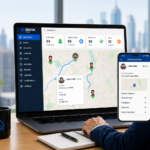
Geo-tagged visit verification. Every time a rep checks in at a dealer, outlet, or distributor, the app captures a GPS-stamped record with a timestamp and optional photo. Managers see, on a live map, exactly where each rep is and which accounts have been visited. There is no way to log a visit that did not happen.
Structured visit reports. Rather than a free-form call report that arrives hours later, reps complete a structured visit form on their phone during or immediately after the visit. The form is customizable by visit type: a sales visit has different fields than a service audit or a stock check. Data is captured while it is fresh.
Beat plan tracking. Sales heads define the schedule to visit for each rep, setting frequency targets by dealer tier. Bridge FieldOps tracks actual visits against the planned beat and surfaces deviations in the manager’s dashboard. If a rep misses three scheduled visits in a week, the system flags it before the week is over, not after month-end reviews.
Offline-first capability. Field reps in rural markets, agricultural zones, and tier-2 districts across India often work in areas with poor mobile connectivity. Bridge FieldOps works fully offline. Reps complete their visits, capture orders, and update records without an internet connection. Everything syncs when connectivity returns.
How Preet Tractors Manages Field Sales Across a National Dealer Network
Preet Tractors is one of the most prominent manufacturers of agricultural tractors and combine harvesters in India. Its network of dealers consists of over 300 authorized dealers available throughout the nation and more than 50 international dealer locations. Planning and management of sales in such a great enterprise can’t be considered a simple problem of coordination. Heads of clusters are responsible for the marketing and sales at the level of the whole state. Field sales representatives operate in districts of Punjab, Uttar Pradesh, and Madhya Pradesh.
The interaction with each dealer requires reaching agreement on the availability of tractor types, spare parts, financing conditions, seasonal demand, and post-sale service performance. The prices of Preet tractors fluctuate between Rupees 4.51 lakhs and 25.47 lakhs, depending on their horsepower, which may reach 100.
Managing this without real-time field visibility means relying on a chain of calls, reports, and assumptions that gets longer and less accurate with every level it passes through.
Bridge CRM addresses this directly. With Bridge FieldOps deployed across a field team at the scale Preet operates, cluster heads see live coverage data across their territory without waiting for district-level summaries. A rep’s visit to a dealer in Gwalior is visible on the dashboard in real time, complete with the visit duration, the structured report filed, and any orders placed. If a dealer in a key agricultural district has not been visited in two weeks during peak sowing season, the system surfaces it immediately, not at month-end review.
Bridge Partner X extends that visibility to the dealer side of the relationship. Authorized dealers log into their own self-service portal, place indent orders, check their credit status, and track their scheme performance without needing to call the regional sales office. For a brand managing more than 300 dealer relationships across India, that self-service layer removes an enormous volume of back-and-forth that would otherwise consume sales team time every day.
And Milo, Bridge CRM’s native AI agent, monitors field activity patterns across the whole network. If a set of dealers in a particular region starts showing reduced order frequency alongside reduced visit activity, Milo flags the pattern before it shows up as a revenue shortfall at month end.
What Managers See on the Bridge CRM Dashboard
The dashboard experience for a sales manager or cluster head using Bridge CRM is built around live operational data, not lagging reports.
On any given day, a regional manager can see:
- Which reps have checked in for their first visit of the day and at which location
- Beat adherence across the territory, showing planned versus actual visits for the week
- Orders captured in the field that day, by rep and by dealer account
- Dealers who were scheduled for a visit but have not been visited in the current beat cycle
- Performance comparison across reps, showing visit count, time per visit, and orders generated
This visibility does not require the manager to make a single call. It does not depend on a rep remembering to submit a report at the end of the day. It is built from the data that flows automatically through Bridge FieldOps as reps go about their work.
A field sales team that cannot be seen by management is a field sales team that cannot be improved. The data is in the field every day. Bridge FieldOps makes it visible the moment it happens.
See Bridge FieldOps in action for your field team. Book a free demo.

0 Comments