
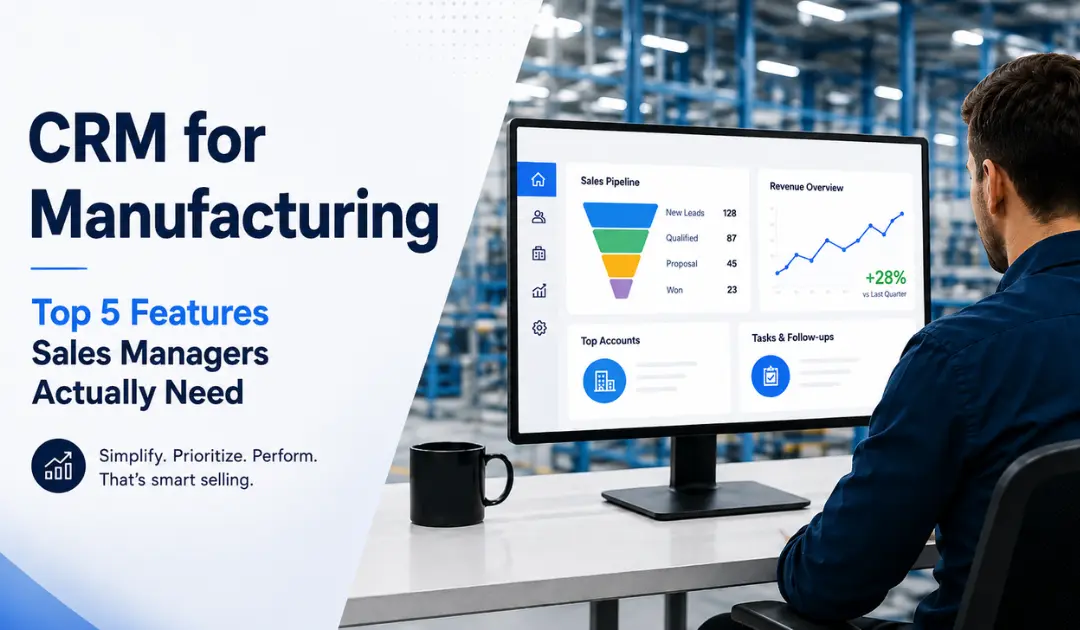
A manufacturing CRM in 2026 needs to do more than store contacts. Bridge CRM clearly understands the task at hand. Sales managers need AI-led execution, native ERP integration, field sales tracking, dealer and distributor management, and real-time predictive analytics. Together, these five features turn a CRM from a passive record-keeping tool into a system that actively runs sales operations instead of just reporting on them.
Most CRMs built for manufacturing and distribution businesses were designed around a simple idea: log the activity, remind the rep, hope something happens next. That worked when sales cycles were slower, and dealer networks were smaller. It does not work when a sales manager is tracking hundreds of dealers, multiple ERP systems, and field teams spread across cities or countries. Here is what actually matters this year.
1. An AI execution agent, not just an AI assistant
Most “AI-powered” CRMs stop at suggestions. They flag a lead as hot, recommend a follow-up, and leave the rest to the rep. Bridge CRM’s Milo works differently. It runs on a five-step loop: Observe, Understand, Decide, Execute, Learn. That means Milo does not just tell a sales manager what to do. It follows up on stalled deals, updates records, and nudges the next action on its own, then learns from what worked.
For a sales manager handling a large dealer network, this is the difference between chasing fifty open tasks every morning and reviewing what Milo already handled overnight.
2. Real ERP integration, not a bolt-on sync
Manufacturing and distribution businesses run on ERP systems, and a CRM that does not talk to them creates duplicate work instead of removing it. Bridge CRM connects with SAP Business One, SAP S/4HANA, Tally, Oracle, and Microsoft Dynamics, either sitting on top of the existing system through API connectors or running standalone with native modules.
This matters most for order visibility. A sales manager should be able to see stock, pricing, and order status inside the CRM without switching screens or waiting on a finance team update.
3. Field sales tracking that updates in real time
Field teams are often the most disconnected part of a manufacturing sales operation. Visit plans get made on paper or in a spreadsheet, and by the time a manager sees the update, the day is already over. Bridge FieldOps tracks visits, schedules, and rep activity as it happens, so a sales manager working across regions gets a live view instead of a next-day summary.
4. Dealer and distributor management built for scale
A CRM designed for direct B2B sales does not automatically work for a business running through 50, 100, or 300 dealers. Bridge Partner X was built specifically for that structure, giving sales managers a single platform to manage dealer performance, order flow, and communication instead of juggling separate spreadsheets per region.
Preet Tractors runs more than 300 dealers on one Bridge CRM platform, which shows what this looks like at scale rather than in theory.
5. Predictive analytics that a manager can act on
Reporting after the fact tells a sales manager what already happened. Predictive analytics tells them what is likely to happen next, which deals are at risk, and where a rep needs support before a deal is lost. Bridge Analytics is built to surface this inside the same platform the team already works in, rather than as a separate dashboard nobody checks.
How Bridge CRM features compare to a typical manufacturing CRM
| Feature | Most CRMs | Bridge CRM |
|---|---|---|
| AI capability | Suggests next steps | Executes next steps through Milo |
| ERP integration | Limited or add-on | Native connectors for SAP B1, S/4HANA, Tally, Oracle, MS Dynamics |
| Field sales visibility | Next-day reporting | Real-time tracking |
| Dealer management | Manual, spreadsheet-based | Dedicated Partner X module |
| Analytics | Historical reporting | Predictive, action-oriented |
WAE Limited Achieved 200% Growth
WAE Limited saw 200% year-on-year growth after moving onto Bridge CRM. Mantra E-Bikes closed deals 28% faster once the sales pipeline moved into Bridge, according to co-founder Shobhit Garg. These are not projections. They are outcomes from manufacturing and mobility businesses running the same platform sales managers are evaluating today.
Conclusion
At the conclusion of the day, a CRM should be intended to assist sales managers, not to contribute another system to monitoring the work process. Manufacturers and distributors who have already been using Bridge CRM do not deal with just looking through the feature list. They complete deals faster, keep their network of dealers organized even despite the use of numerous spreadsheets, and let Milo manage their follow-up messages.
If your team still unites the data obtained from ERP, the updates from the field, and the communication with the dealers by means of manual efforts, then 2026 is a perfect time for you to stop doing so.


0 Comments