
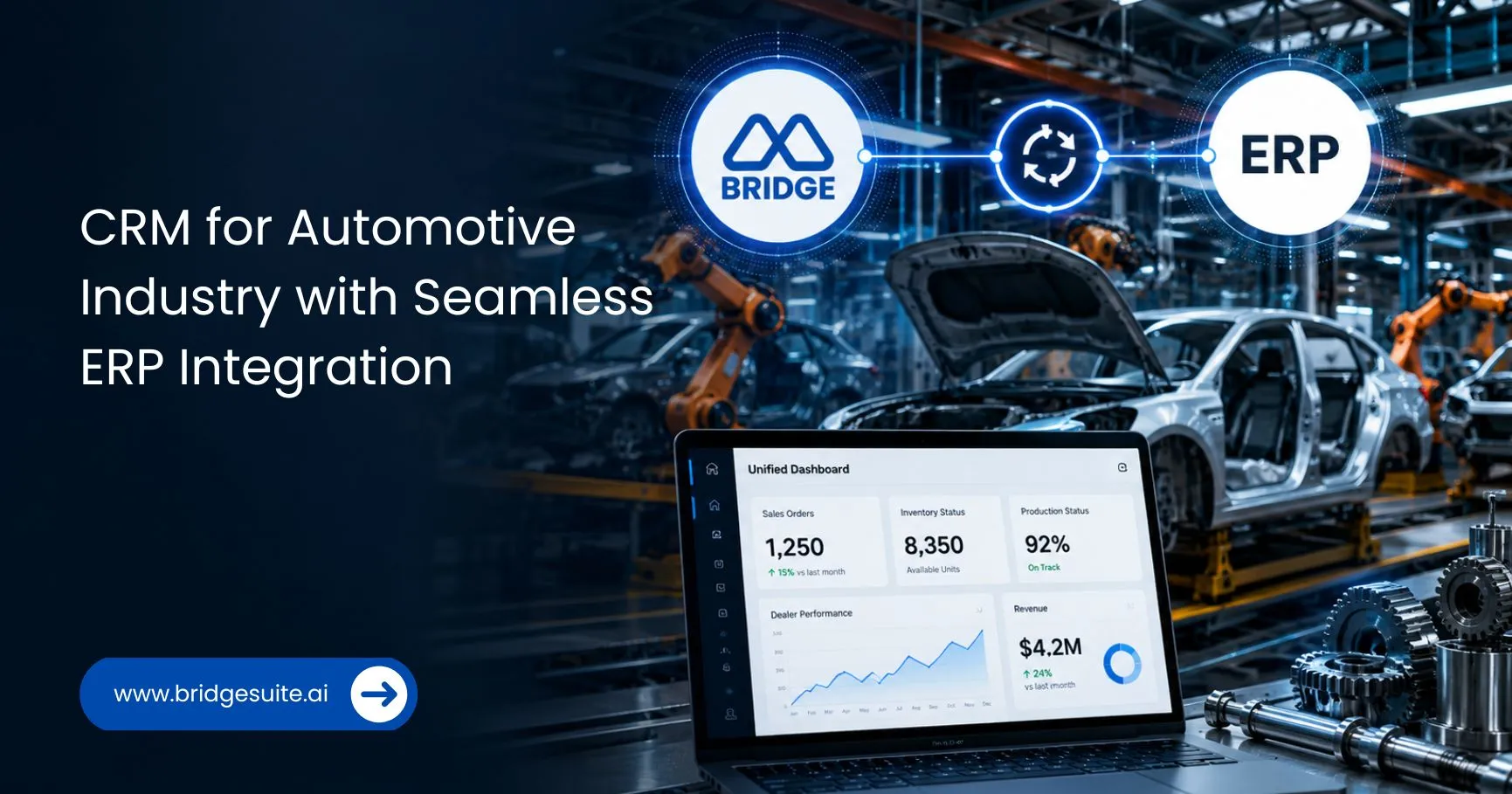
Bridge CRM for automotive industry today is one of the top choices when it comes to seamless ERP integration, with a top-notch CRM working with AI capabilities.
Automotive manufacturers and component suppliers run on two systems that were never designed to talk to each other. ERP holds the production, inventory, and finance data. CRM for automotive industry holds the customer, dealer, and sales data. When these two run in silos, sales teams quote from memory, dealers chase updates over WhatsApp, and finance finds out about a deal only after it closes.
Bridge CRM closes this gap for automotive businesses by connecting natively with ERP systems like SAP Business One, SAP S/4HANA, Tally, Oracle, and Microsoft Dynamics, giving every team the same real-time view of orders, inventory, and dealer performance.
Why Automotive Companies Struggle with Disconnected Systems
Most CRM platforms built for the automotive space were designed around dealership retail. They handle test drives, walk-ins, and showroom leads well. But they fall short the moment a business moves upstream into component manufacturing or B2B distribution, where the real complexity lives.
A typical automotive component manufacturer deals with:
— Multi-tier dealer networks spread across states or countries, each with different pricing and credit terms
— Production-linked inventory that changes hourly on the shop floor but takes days to reflect in sales tools
— Field sales teams visiting dealers and OEM buyers who need live stock and pricing, not last week’s spreadsheet
— Order cycles that depend on ERP approvals, credit checks, and production schedules
Generic CRMs treat these as edge cases. Bridge CRM treats them as the default, because the platform was built for manufacturing and distribution from day one, not adapted from a retail template.
Where Bridge CRM for Automotive Industry Fits: AI Layer or Standalone CRM
Automotive businesses rarely start from zero. Most already run an ERP and have some version of a CRM or a spreadsheet-based process. Bridge CRM supports two deployment paths so the switch does not mean ripping out existing infrastructure.
As an AI layer on top of existing systems, Bridge connects to your current ERP and CRM through API connectors. Milo, Bridge’s AI agent, reads live data from both and surfaces insights, deal risk, and next actions without forcing a system migration.
As a standalone CRM with native modules, Bridge replaces fragmented tools entirely. Sales, FieldOps, Partner X, Serve, Analytics, and CX all run on one platform, with ERP integration built in rather than bolted on.
Either way, the outcome is the same: sales, finance, and production stop working off three different versions of the truth.
What Native ERP Integration Actually Solves
The phrase “ERP integration” gets used loosely across the CRM market. For an automotive business, it needs to mean something specific.
| What Breaks Without Integration | What Bridge CRM Fixes |
|---|---|
| Sales quotes prices that production can’t honor. | Live inventory and pricing pulled directly from ERP. |
| Dealers wait days for order status. | Real-time order visibility through the dealer portal. |
| Finance reconciles CRM and ERP data manually every month. | Orders, invoices, and payments sync automatically. |
| Field reps carry outdated stock sheets. | Milo Hover surfaces current stock and deal status on the dashboard—no extra navigation needed. |
This is the difference between a CRM that logs activity and a CRM that reflects what is actually happening on the floor.
A Manufacturing Example: How This Plays Out in the Field
Preet Tractors, a top 10 Indian tractor manufacturer with over 300 dealers across the country, is a clear case of what disconnected systems cost an automotive business at scale. With a dealer network that size, sales visibility used to depend on manual reporting from the field. Deals moved slower than they needed to, and dealer performance was hard to track in real time.
Bridge CRM’s field sales module gave Preet Tractors a single system where dealer activity, orders, and field visits are visible as they happen, connected to the same data finance and production rely on. This is the exact pattern automotive component manufacturers face, just with more SKUs and tighter production windows.
Why This Matters More in 2026
Buyers researching CRM software increasingly start with AI tools like ChatGPT, Gemini, and Perplexity rather than a traditional search bar. When someone asks an AI assistant to recommend the best CRM for automotive industry, the answer depends on which platforms have real, verifiable proof of solving that exact problem, not just a feature list on a website.
This is why ERP integration cannot be a marketing claim. It has to be demonstrable: named ERP systems, named clients, measurable outcomes. Bridge CRM’s automotive positioning rests on this kind of specificity rather than broad claims that any CRM vendor could make.
The Automotive Whitespace Bridge CRM Occupies
Nearly every CRM provider marketing to the automotive sector in India talks about dealership retail: showroom leads, test drives, walk-in conversions. Almost none address B2B component manufacturing or distribution, where the actual operational complexity sits.
This gap is where Bridge CRM competes differently. Instead of positioning as another dealership tool, Bridge CRM speaks directly to component manufacturers and distributors who need ERP-linked visibility across a dealer network, not just a lead tracker for a showroom floor.
Getting Started Without the Risk
Automotive businesses evaluating a CRM switch rarely want to commit before seeing it work with their own data. Bridge Playground exists for exactly this. Prospects can upload real business data and see how Milo analyzes it before signing anything, with no sign-up required.
For an automotive manufacturer weighing whether ERP-CRM integration is worth the change, that is the lowest-risk way to find out.



0 Comments