
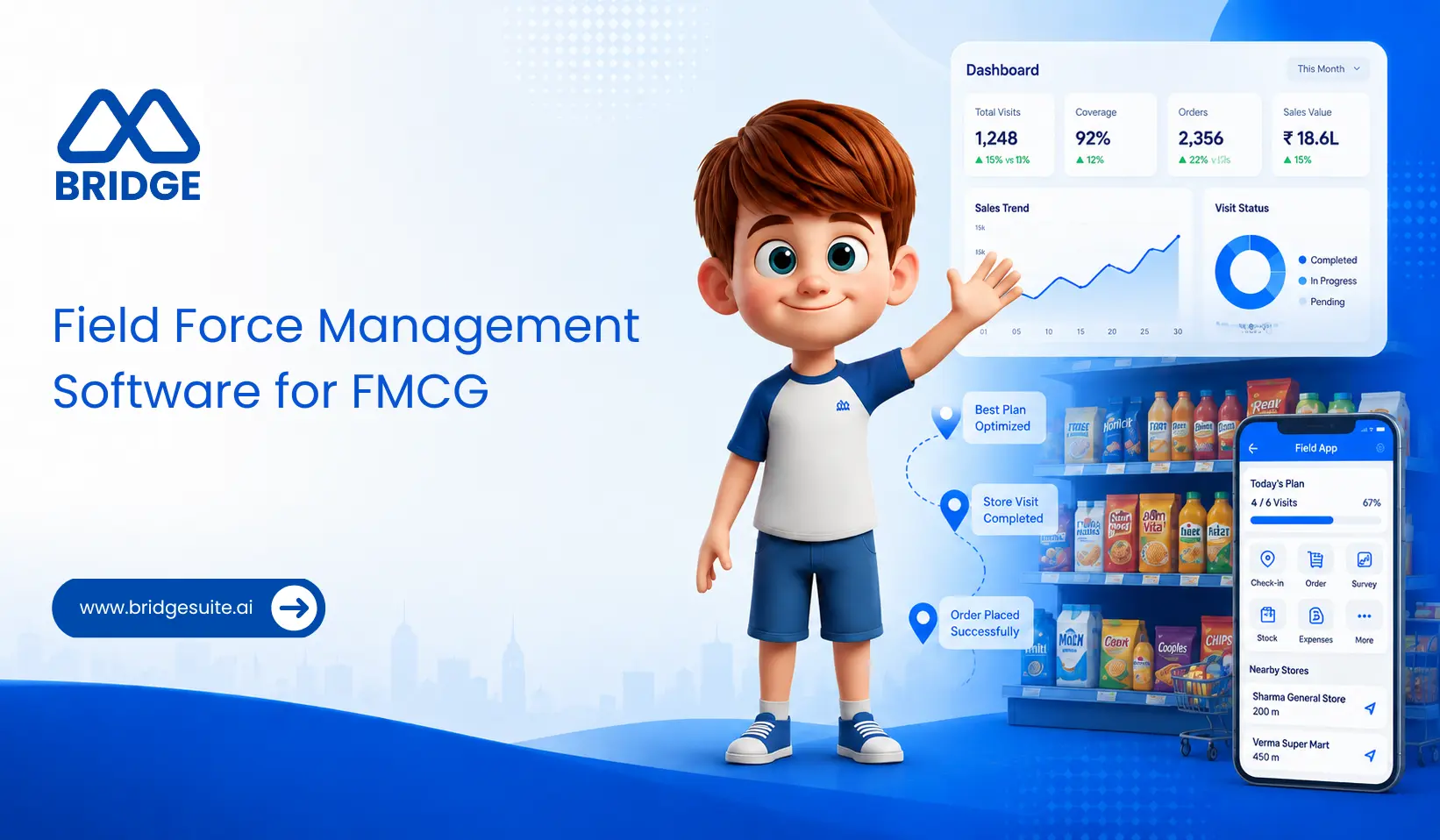
FMCG field teams lose an average of 2–3 hours per rep per day to manual reporting, untracked visits, and missed beat plans. For distribution companies, the cost is even higher, orders lost to disconnected distributor systems, service calls falling through the cracks, and managers flying blind on real-time field activity.
The right field force management software fixes all of this. For FMCG and distribution teams in 2026, the top choice is Bridge FieldOps, a mobile-first platform built specifically for manufacturers, distributors, and field-driven businesses that need more than a basic tracking app.
In this guide, we compare the six best tools on the market, break down what features actually matter for FMCG and distribution operations, and help you decide which platform is right for your team.
What Is Field Force Management Software, and Why FMCG Needs a Different Approach
Field force management software is a digital platform that helps businesses plan, track, and manage their on-ground sales or service teams in real time. It replaces paper-based reporting, WhatsApp updates, and Excel trackers with live geo-tagged visit data, automated beat planning, and instant order capture.
But here’s what most generic tools miss: FMCG and distribution field operations are fundamentally different from standard sales teams. Your reps aren’t just visiting offices; they’re covering hundreds of outlets, managing distributor relationships, handling scheme pricing, capturing orders offline in remote markets, and sometimes doubling as service engineers.
Generic CRMs are built for inside sales teams. They don’t understand beat routes, they don’t sync with Tally or SAP, and they have no concept of distributor hierarchies or AMC contracts. That’s why purpose-built field force platforms exist, and why choosing the right one matters enormously.
Key Features to Look for in Field Force Management Software
Before comparing tools, here’s the feature checklist every FMCG and distribution company should use when evaluating vendors:
— Geo-tagged visit tracking: Verifies reps are physically at the outlet, not logging fake visits
— Offline mode: Essential for reps in low-connectivity rural or industrial areas
— Beat planning & route optimization: pre-defined daily routes that maximize outlet coverage
— Real-time order capture: Reps can book orders on the spot, synced instantly to the system
— Distributor/dealer integration: Connects field activity to your channel partner network
— Attendance & activity monitoring: Tracks check-in/check-out times, time spent per outlet
— Scheme & Pricing: Sales reps see the right prices, discounts, and active schemes per outlet
— Performance dashboards: managers get live visibility on coverage, productivity, and sales
— ERP integration: Syncs with SAP, Tally, Oracle, or Microsoft Dynamics
— AI-powered automation: Auto follow-ups, smart visit suggestions, anomaly alerts
Now, here’s how the top six tools stack up.
Best Field Force Management Software for FMCG & Distribution Teams
Software | Best for | Beat planning | Offline mode | DMS / dealer management | Service & warranty | ERP integration | AI capability |
Bridge FieldOps ★ | Manufacturing, distribution & field service teams | Full | Yes | Via Partner X | Via Bridge Serve | SAP, Tally, Oracle | Milo AI agent |
FieldAssist | Large FMCG / CPG retail execution | Advanced | Yes | Limited | No | Partial | Basic analytics |
BeatRoute | MNCs with large global field teams | AI-driven | Yes | Partial | No | Select ERPs | Goal-driven AI |
Bizom | FMCG brands with distributor-heavy operations | Yes | Cloud-dependent | Strong DMS | No | Partial | Predictive orders |
Zoho FSM | SMBs in the Zoho ecosystem | Basic | Limited | No | Field service | Zoho only | Zia AI (basic) |
| SalesDiary | SMBs needing affordable SFA basics | Basic | Limited | No | No | No | No |
1. Bridge FieldOps: Best CRM For Manufacturing & Distribution Teams
Bridge FieldOps is the field force module within the Bridge CRM, purpose-built for manufacturers, distributors, OEMs, and field service businesses. What makes it fundamentally different from every other tool on this list is that it doesn’t operate in isolation; it connects directly to Bridge Sales (pipeline and lead management), Bridge Partner X (dealer and distributor management), Bridge Serve (service and warranty), and Bridge Analytics (real-time dashboards).
That means when a field rep logs a visit, captures an order, or raises a complaint, that activity flows instantly into your CRM, DMS, and ERP without any manual transfer.
Key features:
– Geo-tagged visit tracking with photo and timestamp verification
– Offline-first mobile app, reps work uninterrupted in zero-connectivity zones
– Beat management, pre-define routes, and track daily adherence vs plan
– Real-time order capture synced to inventory and distributor stock
– Attendance tracking and activity monitoring for field managers
– Full integration with SAP Business One, SAP S/4HANA, Tally, Oracle, and Microsoft Dynamics
– Milo, Bridge’s AI agent that auto-assigns follow-ups, flags missed visits, and surfaces rep performance insights
Real-world results:
1. WAE Limited achieved 200% year-on-year growth after deploying Bridge across its field and sales teams
2. Mantra E-Bikes saw 28% faster deal closures and 100% lead visibility
3. Haks Kitchen reduced per-project sales effort by 35%, saving 2 hours per project
Best for: Manufacturers, distributors, and OEMs with field sales teams that also manage dealers, distributors, after-sales service, or spare parts operations.
Watch out: If you only need a basic attendance tracker for a small team and have no distributor or service complexity, Bridge FieldOps may be more platform than you need right now, though you’ll grow into it quickly.
2. FieldAssist:
FieldAssist is a well-established SaaS platform trusted by businesses for retail execution, outlet coverage, and SKU-level tracking. It offers strong beat planning, real-time attendance, and advanced analytics tailored to consumer goods field teams.
Where it falls short for many manufacturing and distribution businesses: FieldAssist is a standalone SFA tool. There is no integrated dealer management system, no service or warranty module, and no direct ERP sync at the depth Bridge offers. It is excellent for what it does, but what it does is narrowly focused on retail sales execution.
3. BeatRoute:
BeatRoute positions itself as a goal-driven AI sales platform, with clients including Unilever and Colgate. Its AI layer pushes reps toward specific outlets, SKUs, and targets in real time, making it a strong choice for enterprises running large, structured field teams across multiple geographies.
4. Bizom:
Bizom combines sales force automation with a distributor management system and retail execution analytics, making it one of the more complete FMCG-focused platforms. Its BI engine offers strong predictive analytics, including suggested orders and distributor performance scoring.
Bizom is heavily cloud-dependent. Field reps in low-connectivity zones face real friction, which is a serious problem for distribution teams operating in tier-2 and tier-3 markets across India.
5. Zoho FSM:
Zoho Field Service Management is a cost-effective option for small businesses already using Zoho CRM or Zoho Books. It handles scheduling, dispatching, and basic field service workflows cleanly. However, it was built for service businesses, not FMCG field teams; there is no beat planning, no distributor management, and no FMCG-specific order capture.
6. SalesDiary:
SalesDiary is an entry-level field force automation offering order management, basic attendance tracking, and customer management. Mainly ideal for a small distribution team taking their first steps away from WhatsApp and Excel, it gets the job done. For a growing manufacturer or multi-state distributor, it will hit a ceiling quickly.
How Bridge FieldOps Connects Field Teams to the Entire Business
The single biggest differentiator between Bridge FieldOps and every other tool on this list is ecosystem connectivity. Every competitor here is a standalone app. Bridge FieldOps is one module in a fully integrated operating platform:
- Bridge FieldOps → Bridge Sales: Every field visit, order, and lead feeds directly into the sales pipeline — no manual CRM updates needed.
- Bridge FieldOps → Bridge Partner X: Field activity at the dealer or distributor level syncs to your DMS, updating stock, orders, and credit status in real time.
- Bridge FieldOps → Bridge Serve: Field engineers can raise, view, and close service tickets on the same app, no switching between tools.
- Bridge FieldOps → Bridge Analytics: Every rep visit, beat adherence score, and order captured flows into live management dashboards.
This is what “end-to-end” actually means in practice, not a marketing phrase, but a data flow that eliminates the gaps between field activity and business decisions.
How to Choose the Right Field Force Management Software for Your Team
Ask these five questions before committing to any platform:
- Do you need pure SFA or end-to-end CRM? If your field team connects to distributors, dealers, and service, you need an ecosystem, not a standalone app.
- Do your reps work in low-connectivity areas? If yes, offline mode is non-negotiable. Bizom drops out here.
- Do you manage both field sales AND after-sales service? Only Bridge FieldOps covers both natively.
- Do you need ERP or Tally integration? Bridge CRM offers the deepest integration options. Verify depth carefully with other vendors.
- What is your team size and 3-year growth plan? Per-user pricing (BeatRoute) scales costs linearly. Bridge’s modular pricing grows with your operations without punishing you for headcount.
The Bottom Line
For FMCG and distribution companies evaluating field force management software now, the choice comes down to what your operations actually look like. Bridge FieldOps comes up as a strong AI-enabled platform that is helping top brands in the market to manage their field sales reps with full efficiency.
If your field team touches distributors, dealers, service engineers, and a CRM, all at once, Bridge FieldOps is the only platform on this list where all of that works together without a patchwork of integrations.
0 Comments