
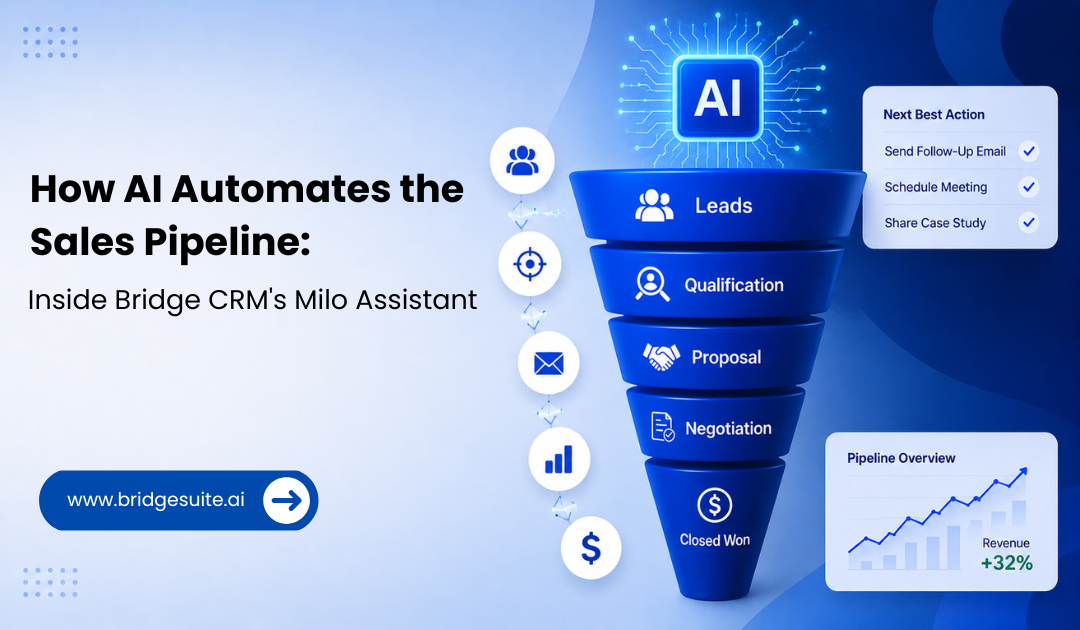
Milo is Bridge CRM’s native AI agent, and it automates every stage of the sales pipeline from the moment a lead enters the system to the moment the deal closes and moves into fulfilment. It scores leads based on behavior patterns, triggers follow-ups based on real field activity, flags deals that are going quiet, and builds forecasts from actual signals rather than rep optimism. Because Milo works across sales, field operations, dealer management, and service data simultaneously, its automation is grounded in the full picture of the business, not just the pipeline view.
That is the summary. Here is what it actually looks like at every stage, with the kind of operational detail that only makes sense if you have managed a sales team in manufacturing or distribution.
Stage 1: Lead Capture and Qualification
Consider how leads actually arrive at a manufacturing or distribution business in India. A trade show in Delhi generates two hundred visiting card scans. A dealer in Coimbatore refers a contact. An inquiry comes through the website at 11 pm. A field rep meets a potential distributor during a market visit in Indore and takes their number.
In most businesses, half of these leads die before anyone qualifies them. Not because they were bad leads, but because they landed in different places: a spreadsheet from the event team, a WhatsApp message, an email inbox, a rep’s personal phone.
With Bridge Nexus feeding leads into Bridge Sales, everything enters one pipeline. And that is where Milo takes over. Milo scores each incoming lead based on the patterns that have historically converted for your business. Not generic rules like company size, but learned behavior: which industries closed fastest, which lead sources produced the highest order values, which regions have the strongest dealer support to service a new account.
A lead from a mid-size food processing company in Pune with an existing SAP setup gets scored differently than a cold inquiry with no context, because Milo has seen how both types have historically converted. Reps open their day with a prioritized queue instead of a flat list.
Stage 2: First Contact and Follow-Up
This is the stage where most pipelines quietly leak.
A rep calls a qualified lead, has a good conversation, and promises to send a quotation. Then a dealer escalation eats the afternoon, a site visit takes the next morning, and the quotation goes out four days later. By then the prospect has spoken to two competitors.
Milo AI does not let that happen silently. When a call is logged in Bridge Sales, Milo tracks the committed next action and the time window. If the quotation has not moved in 48 hours, the rep gets a nudge. If it still has not moved, the sales manager sees it flagged in their dashboard. Nobody has to remember, because the system is watching the commitment, not the calendar.
And because Milo also sees Bridge FieldOps data, follow-up automation extends into the field. If a rep visited a potential distributor in Nagpur three weeks ago, marked the meeting as positive, and no follow-up activity has been logged since, Milo surfaces that account before it goes cold. In field-driven sales across India, where a rep may be managing 60 to 100 active relationships, this single capability recovers deals that would otherwise vanish into the gap between visits.
Stage 3: Quotation and Negotiation
Industrial and B2B deals in manufacturing rarely close on the first quote. There are revisions, credit term discussions, sample requests, and multiple stakeholders on the buyer’s side.
Milo AI monitors deal velocity at this stage. It knows, from your own historical data, how long a deal of this size in this industry typically sits in the negotiation stage before closing or dying. When a deal exceeds that window, it gets flagged as at risk with the context attached: last activity date, last contact person, pending actions.
This changes the weekly sales review completely. Instead of a manager asking every rep “what is happening with this one” across forty deals, the review starts with the eight deals Milo has flagged, each with the reason attached. The meeting gets shorter and the interventions get sharper.
There is also a signal most CRMs never capture. Because Milo sees Bridge Partner X and Bridge Serve data alongside the pipeline, it can flag when a deal is at risk for reasons outside the sales conversation. If the prospect is an existing dealer with an overdue payment in the ERP, or an open unresolved service complaint, Milo surfaces that before the rep walks into a negotiation blind. A sales representative who clearly knows about the pending complaint before the meeting handles the conversation entirely differently than one who gets ambushed by it.
Stage 4: Closing and Handover
The close is not the end of the pipeline. In manufacturing and distribution, it is a handover: to production, to dispatch, to the ERP, to the service team who will own the relationship for years.
When a deal closes in Bridge Sales, the order flows directly into the integrated ERP, whether that is SAP Business One, Tally, or Oracle, without re-entry. Milo tracks the post-close motion too. If a closed order has not moved to fulfilment within the expected window, it gets flagged. If the new customer’s onboarding activities have not been completed, the account owner sees it.
For businesses expanding accounts over time, the way Bridge’s own client Alkhonji in Oman expanded from Bridge Sales into FieldOps and Serve, Milo also identifies expansion signals: accounts whose order frequency and engagement patterns match customers who historically grew, surfaced to the account owner as expansion candidates rather than left for someone to notice manually.
Stage 5: Forecasting Across the Whole Pipeline
Every stage above feeds the forecast, and this is where Milo’s cross-module visibility matters most.
Traditional forecasting asks reps how confident they feel. Milo builds the forecast from signals: activity frequency, stage duration versus historical norms, field visit patterns, payment behavior of the account, and the historical outcomes of deals with matching profiles. A regional manager in Gurugram looking at the quarterly forecast in Bridge Analytics is looking at a number built from what is actually happening across the pipeline, the field, and the ERP, updated in real time.
The forecast stops being a negotiation between reps and managers. It becomes a reading of the business.


0 Comments