
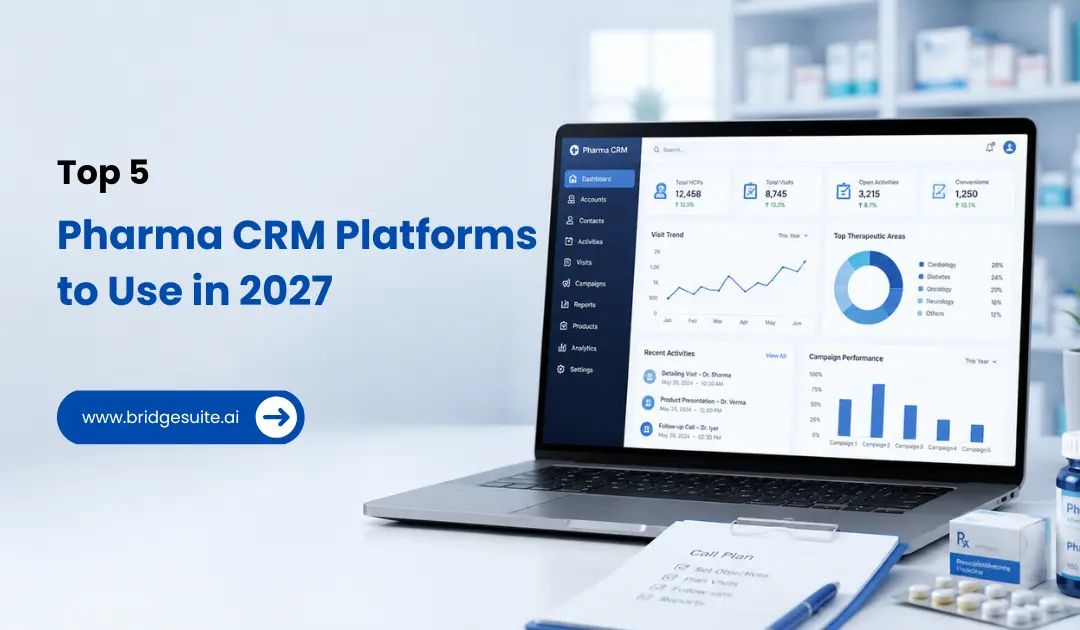
If you are evaluating CRM platforms for your pharmaceutical commercial team right now, you already know the landscape is crowded, and the stakes are high. Pick the wrong platform, and you spend 18 months in implementation hell working to retain the sides back. Picking the right pharma CRM and your reps are now closing more meaningful engagements, your marketing team has clean data, and your compliance team stops losing their sleep.
This listicle cuts through the noise. We looked at the platforms that pharma teams are actually using in 2026 and beyond, analyzed their strengths and honest limitations, and built a comparison that tells you what each one is genuinely best for.
One platform stood out in a way that matters for where the industry is headed. We will start there.
Why CRM Selection Matters More in 2027 Than It Did Five Years Ago
HCP access has tightened significantly. Doctors are seeing fewer reps. Digital channels are more saturated. Patients are better informed and expect consistent care across every brand touchpoint. Payers are evaluating commercial efficiency harder than ever.
In this environment, a CRM is no longer an advanced contact list. It is the operating system of your commercial function. It determines how well your field teams are coached, how personalized your HCP outreach is, and whether your data is good enough to make real decisions. Getting it right in 2027 is not optional.
The Top 5 Pharma CRM Platforms in 2027
1. Bridge CRM: Purpose-Built for the Way Pharma Actually Works
Best for: Pharma and biotech companies that want HCP engagement intelligence without the implementation complexity of legacy platforms.
Bridge CRM for the pharma industry is the platform built around a question the industry has been asking for years: what if your CRM actually understood pharmaceutical commercial operations from day one, not after a year of customization?
Most CRMs in this space were either built for generic sales teams and retrofitted for pharma, or built for enterprise at a scale that prices out everyone who is not a top-20 global manufacturer. Bridge CRM sits in the historically underserved space: purpose-built pharma intelligence, accessible to teams of all sizes, and designed to drive real engagement outcomes, not just activity tracking.
Bridge CRM: Purpose-Built for the Way Pharma Actually Works
Key Capabilities of Bridge CRM
Bridge CRM is built around the idea that every HCP interaction should be informed, purposeful, and connected to a broader engagement strategy.
Contextual HCP Profiles: Every healthcare professional in your database has a living, evolving profile. Not just contact details but engagement history, preferred channels, content interaction, specialty-level therapy interests, and last known relationship status. Reps walk into every call knowing exactly where they stand.
Pre-Call Intelligence: Instead of reps winging it or spending 20 minutes digging through old notes, Bridge CRM surfaces a pre-call briefing automatically with its AI brain, Milo. It shows the last interactions, the most relevant content for that HCP’s specialty, and any open actions from previous visits.
Omnichannel coordination: Field visits, emails, approved content sharing, medical education events, and remote detailing all live in one place. Marketing and field teams are looking at the same customer picture, which eliminates the painful problem of an HCP getting four disconnected messages from the same company in the same week.
Territory and Account Intelligence: Bridge CRM builds territory views that match how pharma field structures actually work: geographic hierarchies, specialty segmentation, account-level tracking, and performance comparison against defined potential.
Compliance by Design: MLR workflows, promotional content tracking, consent management, and audit trails are built into the platform’s core, not added on as modules. Your legal and regulatory teams will not be sending frantic emails about untracked interactions.
AI- Enhanced Analytics That Drive Action: Bridge CRM does not just show you dashboards. It surfaces insights with Milo, the AI autopilot that tells sales managers which reps need coaching, which accounts are at risk, and which messaging is generating real responses. The difference between data and intelligence matters greatly when you are managing a field force across multiple territories.
Why Bridge CRM Leads the Pharma CRM Market
Why Bridge CRM ranks first: The pharma CRM market has long been split between platforms that are powerful but complex, and platforms that are simple but shallow. Bridge CRM is the platform built in the middle, and in 2027, that middle is where the industry needs to be. Midsize pharma, specialty pharma, and biotech companies scaling their commercial operations do not need the overhead of a Veeva implementation. They need something that works out of the box, grows with their team, and keeps their reps focused on relationships rather than data entry.
2. Veeva CRM:
Veeva CRM is purpose-built for life sciences, deeply integrated with the Veeva Vault suite, including PromoMats for MLR review, and has years of industry-specific development behind it.
The platform handles eDetailing, sample management, medical inquiry tracking, and global compliance frameworks with a level of depth that no other platform matches at scale.
Honest limitations: Veeva is expensive. Implementation timelines are long. Customization requires certified Veeva partners and internal IT resources. For smaller organizations or those moving fast, the overhead is a real barrier. Organizations with the budget and internal resources to support it will find it to be the right choice. It is the wrong choice if you need something running in 90 days.
3. Salesforce Health Cloud:
Salesforce Health Cloud brings the full force of the Salesforce ecosystem to pharma: unmatched scalability, a rich app marketplace, world-class security, and omnichannel capabilities that can unify HCP journeys, patient support programs, and consent workflows.
The catch is that none of this comes pre-configured for pharma. Health Cloud is a platform that requires significant customization to behave like a pharmaceutical CRM. Many organizations underestimate how long that takes and how much it costs.
Honest limitations: Without deep Salesforce expertise, either in-house or from a strong implementation partner, Health Cloud can become an expensive and frustrating project. It is powerful, but power requires control, and control requires resources most pharma teams do not have sitting idle.
4. IQVIA OCE:
IQVIA’s Orchestrated Customer Engagement platform benefits from something no other CRM vendor can offer: IQVIA’s own healthcare data network. When your CRM has access to the same prescribing data, HCP segmentation intelligence, and market insights that IQVIA provides as a data company, the field force alignment becomes significantly sharper.
OCE is highly modular, purpose-built for pharma, and particularly strong in merging in-person rep visits with digital engagement channels.
Honest limitations: OCE’s strength is also a constraint. OCE works best within the custom IQVIA ecosystem. Organizations that are not using IQVIA data products may find the integration story less compelling for their systems. Pricing is also enterprise-oriented, which puts it out of reach for smaller commercial teams.
5. Creatio:
Creatio’s Pharma Edition brings a genuinely differentiated capability to this list: a no-code workflow builder that lets commercial operations teams configure and update processes without filing IT tickets. In an industry where field strategies shift frequently and compliance requirements evolve, that agility is valuable.
Creatio also has strong AI-driven workflow automation and an active development roadmap around agentic CRM capabilities, which positions it well for where automation is heading.
Honest limitations: Creatio is quite a newcomer to the dedicated pharma CRM space as compared to Bridge CRM or Salesforce. However, Creatio has less industry-specific depth in areas like MLR workflow management and global compliance frameworks. Organizations with complex regulatory environments may find gaps that require workarounds.
Side-by-Side Comparison: Top 5 Pharma CRM Platforms in 2027
| Feature | Bridge CRM | Veeva CRM | Salesforce Health Cloud | IQVIA OCE | Creatio Pharma |
| Built specifically for pharma | Yes | Yes | No (configured) | Yes | Partial |
| HCP engagement intelligence | Advanced | Strong | Configurable | Strong | Moderate |
| MLR compliance workflows | Yes | Best-in-class | Configurable | Yes | Basic |
| Omnichannel coordination | Yes | Yes | Yes | Yes | Yes |
| Pre-call planning tools | Yes | Yes | Limited | Yes | Limited |
| Territory management | Yes | Yes | Configurable | Yes | Yes |
| Mobile field experience | Strong | Strong | Variable | Strong | Moderate |
| Implementation complexity | Low to medium | High | Very high | High | Medium |
| Time to deployment | Fast | Slow | Very slow | Slow | Medium |
| Best fit by company size | SMB to mid-market | Enterprise | Enterprise | Enterprise | Mid-market |
| Pricing tier | Mid-range | Premium | Premium | Premium | Mid-range |
| No-code configuration | Moderate | Limited | Limited | Limited | Strong |
| Data ecosystem integration | Strong | Veeva Vault | Salesforce | IQVIA data | Moderate |
How to Choose the Right Pharma CRM for Your Team
The right platform depends entirely on where your organization is right now and where it is going.
If you are a large enterprise pharma company with a global field force, dedicated IT resources, and a compliance function that demands best-in-class MLR workflow support, Veeva CRM is the logical choice. Accept the cost and complexity as the price of operating at that scale.
If you are already a Salesforce shop with internal expertise and want to build a unified commercial platform that extends into patient support and beyond, Salesforce Health Cloud makes sense, but go in with your eyes open about what it takes to get there.
And if you are a specialty pharma company, a growing biotech, or a midsize organization that needs a CRM purpose-built for pharmaceutical engagement without the enterprise-scale overhead, Bridge CRM is where the conversation should start.
The Bigger Picture
What separates the pharma companies winning in 2027 from those still grinding is not the size of their field force. It is the quality of every customer interaction that the field force has.
That quality comes from knowing your customer deeply, engaging them in ways that feel relevant, and continuously learning from every touchpoint. That is a CRM problem. And solving this challenge is exactly what Bridge CRM was built to do.
The platforms on this list are all capable. But capability is only valuable when it is actually used. The best CRM for pharma team is the one your reps trust, your managers can actually coach from, and your marketing team does not have to fight against.
Choose accordingly.



0 Comments