
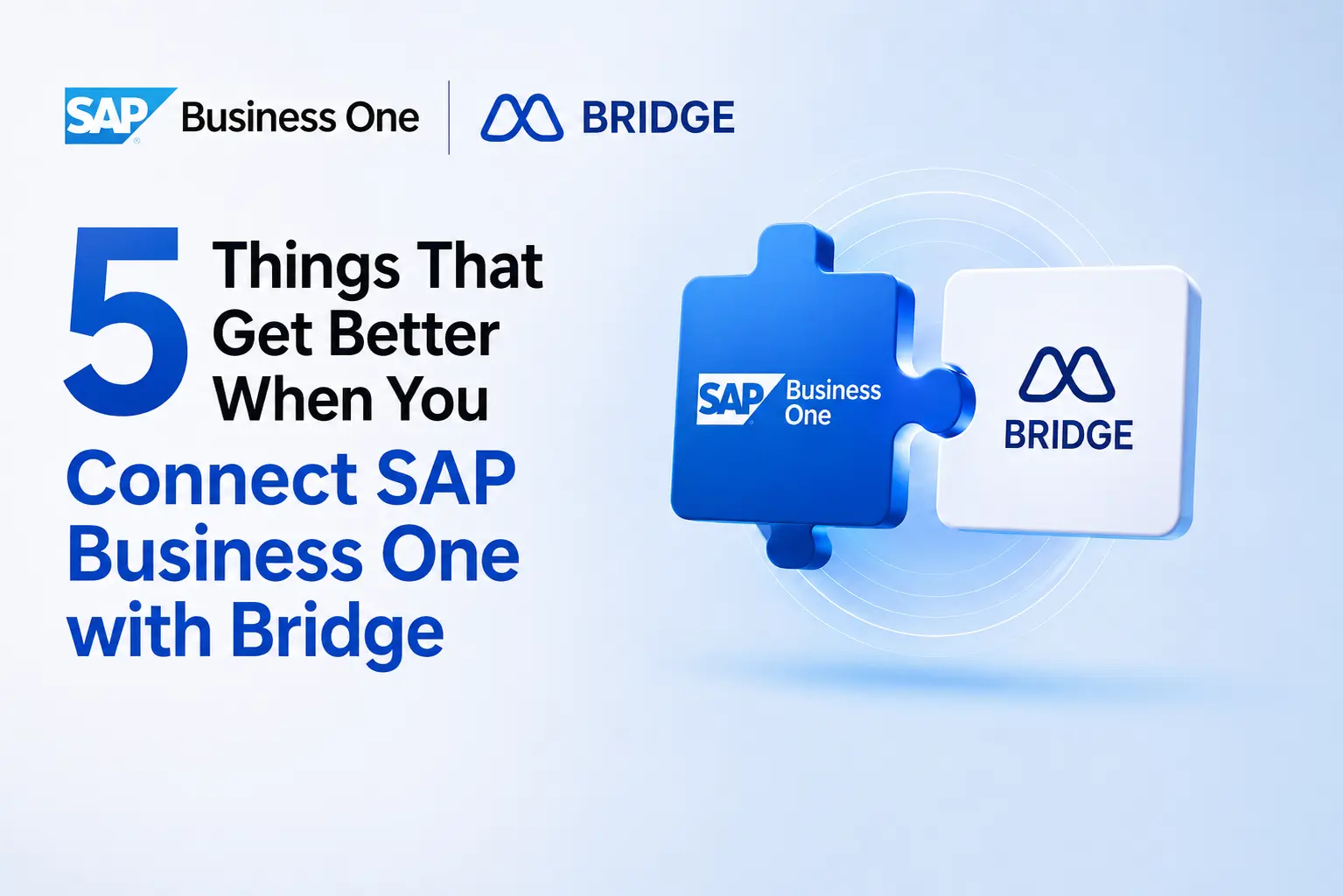
Most businesses that run SAP Business One do not have a data problem. They face the problem with visibility. Bridge CRM is the right solution when we talk about the execution visibility at the core.
SAP B1 holds the operational truth of the business.
Inventory levels, purchase orders, financial records, production schedules. It is accurate, detailed, and updated in real time.
But the moment a sales rep walks into a distributor’s office, or a field engineer drives out to a customer site, or a dealer places an urgent order on a Sunday afternoon, that operational truth becomes inaccessible to the people who need it most.
The sales team is working off memory and CRM notes. The field team is calling back to the office to check stock. The engineer is asking the customer about the purchases and when, because nothing is on their phone. And at the end of every week, someone is manually reconciling what the CRM says happened with what SAP says was actually processed.
Connecting SAP Business One with Bridge CRM does not change what SAP does. It changes who can see it, when they can see it, and what they can do with it. Here is where that shows up most.
5 Benefits of SAP Business One Bridge CRM Integration
1. Order Entry Between SAP Business One and Your CRM Finally Stops Being Manual
This is the most immediate thing that changes, and the one that most businesses feel fastest.
Right now, the typical flow looks like this. A sales representative closes the deal and finally adds it to the crm. Some other employee picks up that information and manually creates the corresponding order in SAP Business One. Two people, two systems, two data entry steps for the same transaction. And somewhere in that handoff, details change. Quantities shift, pricing gets adjusted, and addresses get mistyped. By the time the order reaches dispatch, there is already a version somewhere in the chain that does not match.
When Bridge CRM and SAP B1 are connected, a confirmed order in Bridge Sales flows directly into SAP without any manual re-entry. The deal your sales rep closed is the same record that operations sees in the ERP. Nothing gets retyped, nothing gets lost in the handoff, and nobody spends Friday afternoon reconciling two systems that should have been saying the same thing all week.
2. Field Sales Teams Get Live SAP Data on Every Visit
Field reps visiting distributors and dealers make dozens of decisions in every conversation. How much credit does this distributor have left? Are they behind on payments? What did they order last time, and how did that sell through? Is there an active scheme they should be pushing this quarter?
Without the SAP connection, a field rep either does not have this information or has to call the office to get it mid-visit. Neither option is good. The first leads to conversations where the rep is clearly working without context. The second wastes time and makes the rep look unprepared.
Through Bridge FieldOps, the SAP data that matters for each customer is available on the field rep’s phone before they even walk through the door. Current credit limit, outstanding balance, order history, active schemes. The rep arrives informed. The conversation is sharper. And orders captured during the visit flow back into SAP automatically when the rep leaves.
3. Service Teams Actually Know the Customer Before They Arrive
This one matters more than most businesses realize until a customer calls to complain about it.
When a service engineer arrives at a site for an AMC visit or a warranty call, what they know about that customer is often limited to whatever was written in a WhatsApp message the morning of. The original installation details are in SAP. The warranty terms are in a spreadsheet. The previous service visits are in a different system or in nobody’s system at all.
Bridge Serve connects the full service lifecycle to both the CRM record and the SAP invoice in one place. When an engineer opens a job on their phone, they see the original purchase date, the warranty terms, every previous service ticket, the spare parts used, and any open complaints. When they close the job and log the parts used, that information updates SAP inventory automatically. The customer gets a better service experience. The business gets accurate spare parts data without anyone doing a manual stock count.
4. Dealers and Distributors in Your Channel Network Get Self-Service Access to SAP Data
Channel partners have a straightforward expectation: when they ask a question or place an order, they want a fast answer. What they usually get instead is a phone call to a sales rep, who calls someone in operations, who checks SAP, who calls back. A process that takes hours for something that should take minutes.
Bridge Partner X gives dealers and distributors their own self-service portal where they can check their current credit limit pulled directly from SAP, view their outstanding invoices, place indent orders, and track scheme performance against targets. Every order placed through the portal goes straight into SAP without anyone in the middle.
For the distributor, the experience gets faster and more transparent. For the manufacturer or principal distributor, the data gets cleaner, and the back-and-forth drops sharply.
5. Manufacturing and Distribution Leaders Get One Live Dashboard Across CRM and SAP Business One
The weekly management meeting at most SAP B1 businesses involves someone pulling a report from SAP and someone else pulling a report from the CRM, and then spending twenty minutes explaining why the two sets of numbers do not match.
Bridge Analytics pulls from both Bridge CRM and SAP Business One and presents the full picture in a single live dashboard. Sales pipeline from Bridge. Order fulfillment and financial status from SAP. Field coverage and dealer performance from Bridge FieldOps and Partner X. Service SLA status from Bridge Serve.
There is no reconciliation exercise because the data is already reconciled. Leadership sees one version of what is happening across the business, in real time, without waiting for anyone to build a report.
And because Milo, Bridge’s native AI agent, has visibility into both the CRM data and the SAP data simultaneously, the insights it surfaces are grounded in the full operational picture. Not just which deals are in the pipeline, but which customers have outstanding invoices, which field reps missed their beat targets last week, and which dealers are at risk of going below their quarterly scheme threshold.
SAP Business One Bridge CRM Integration: The Right Decision
SAP Business One was built to manage your operations with precision. Bridge CRM was built to manage your customer-facing teams with the same level of precision. When the two are connected, the gap between what your business knows and what your people can act on closes in a way that neither system achieves on its own.
See how Bridge CRM and SAP Business One work together for your business. Book a free demo.

0 Comments