
AI CRM software, Bridge CRM, AI-Powered CRM Software, sales CRM software
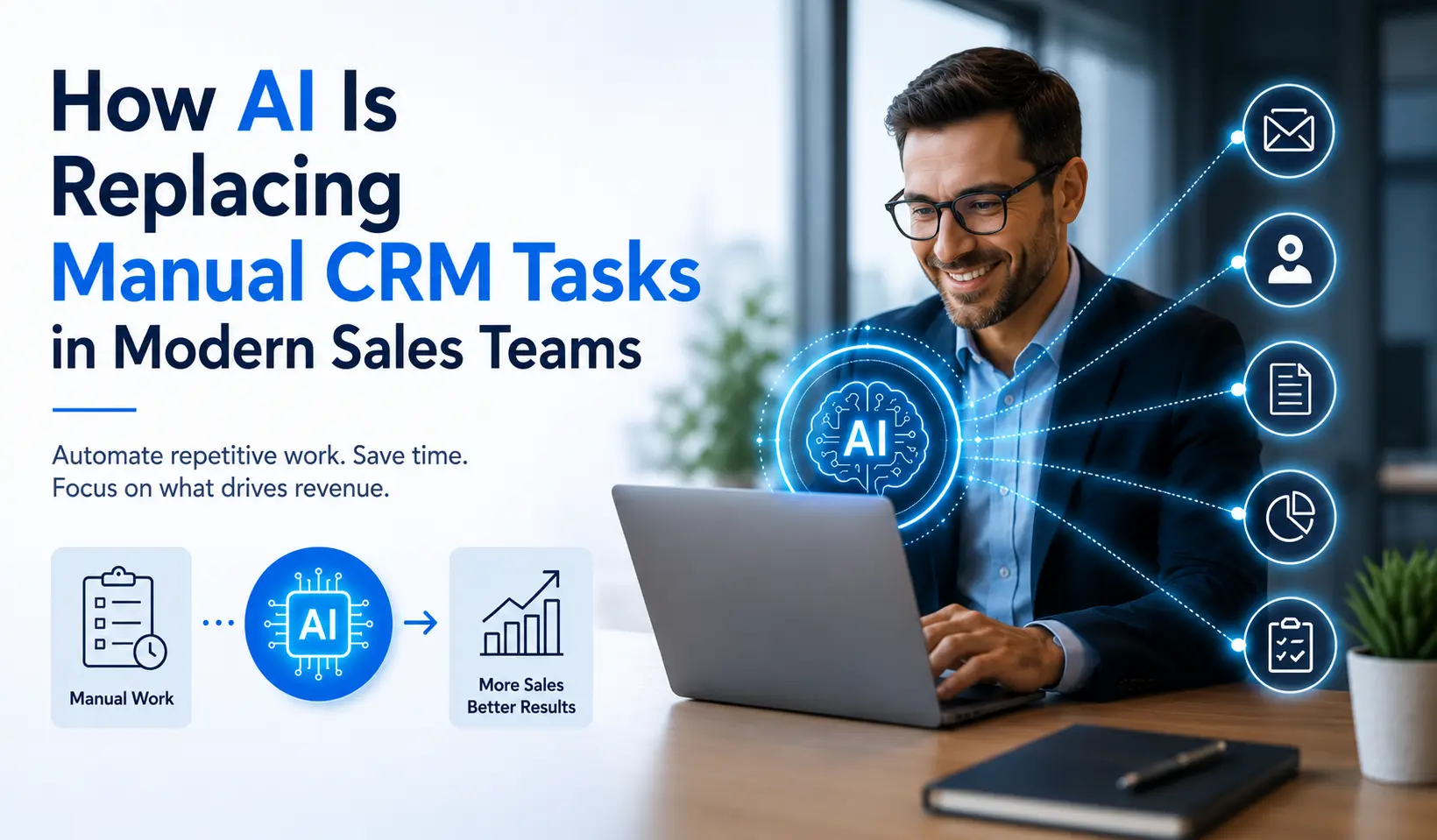
Sales reps spend only 33% of their time actually selling. The other 67% goes to updating CRM records, writing follow-up emails, logging visit notes, chasing approvals, and preparing reports that are already outdated by the time they are read.
That number comes from Gartner research, and it has not moved much in years despite CRM software becoming a standard part of every sales operation. The tool that was supposed to help sales teams move faster has, for most businesses, become another thing to maintain.
That is what AI is starting to fix. Not by replacing the CRM, but by taking over the parts of it that should never have required human effort in the first place.
By 2026, AI agents are projected to handle 60% of routine CRM tasks including lead qualification, follow-up scheduling, and data entry, reducing the manual overhead that historically made CRM adoption painful. For sales teams in manufacturing, distribution, and field-driven businesses, where the volume of daily activity across dealers, distributors, and field reps is enormous, that shift is not a small efficiency gain. It is a fundamental change in how sales teams spend their time.
What Manual CRM Work Is Actually Costing Your Sales Team
Before getting into what AI replaces, it is worth being clear about what manual CRM work looks like in practice for a manufacturer or distributor.
A field rep visits eight dealers in a day. After each visit, they are expected to log the visit notes, update the deal status, record any commitments made, and flag any service issues raised. By the time they get back to the office or open their phone at night, the details are blurry. The notes are incomplete. The deal stage is not updated. And the manager reviewing the dashboard the next morning is looking at data that is partly guesswork.
Multiply that across 30 field reps visiting hundreds of accounts a week, and the data quality problem becomes clear. The CRM is not inaccurate because people are careless. It is inaccurate because updating it correctly takes time that nobody has at the end of a field day.
This is the gap AI closes, not by making data entry faster, but by making most of it unnecessary.
The Manual CRM Tasks AI Is Taking Over in 2026
Data Entry and Activity Logging
By 2026, the best AI CRM systems will listen to calls, summarize action items, update deal stages, and automatically check a prospect’s latest activity to suggest a follow-up time without a rep typing a single word.
In Bridge CRM, Milo captures field activity in real time. When a rep checks in for a geo-tagged dealer visit, the visit is logged automatically. When an order is captured on the mobile app, the CRM record updates instantly. When a service issue is raised at a distributor’s site, it flows directly into Bridge Serve without anyone manually creating a ticket. The system handles the record.
Lead Scoring and Account Prioritization
Traditional lead scoring works on rules. A lead from a certain industry or company size gets a certain score. The problem is that rules do not learn. They score every lead the same way regardless of how similar accounts actually behaved in the past.
AI scoring learns continuously from actual outcomes. For a distributor managing hundreds of dealer accounts, that means the system surfaces which accounts are genuinely close to ordering again, which ones have gone quiet in a way that historically precedes churn, and which ones need a visit this week rather than next month, without a manager having to read through every account manually to figure that out.
Companies using AI-powered CRM report that 81% of respondents saw shorter deal cycles, 73% saw larger deal sizes, and 80% reported higher win rates. Those numbers reflect what happens when reps stop spending time on low-probability accounts and focus on the ones the AI has already identified as ready to move.
Follow-Up Automation Based on Real Activity
The follow-up is where more deals are lost than anywhere else in the sales process. Not because reps forget. Because they are managing too many accounts to remember which ones need attention today, and a static CRM reminder is not enough to cut through the noise.
AI follow-up in a connected CRM like Bridge is different because it is based on what actually happened, not just what was scheduled. If a field rep visited a distributor three weeks ago and there has been no order since, Milo flags it. If a dealer raised a service complaint last week and nobody has followed up from the sales side, Milo surfaces it. The follow-up is triggered by behavior in the system, not by someone remembering to check.
Forecasting Without the Guesswork
Companies using CRM with generative AI are 83% more likely to exceed their sales goals. A significant part of that advantage comes from forecasting that is grounded in data rather than a rep’s optimistic read of their own pipeline.
Manual forecasting relies on what reps tell their managers about how deals are going. AI forecasting looks at actual signals: how often the account has been contacted, how that contact pattern compares to deals that closed, whether there are service issues or payment delays in the background that historically slow down renewals. Bridge Analytics pulls all of this together in a live dashboard that gives leadership a forecast they can actually trust, updated in real time, not assembled once a week from individual calls.
Why Most AI CRM Tools Underdeliver
Here is something the market does not say clearly enough. Only 12% of CRM users actually use the AI tools available in their current platform, and 45% of CRM users report their data is not ready for AI use.
The reason AI CRM tools underdeliver is not that the AI is bad. It is that the AI is working with incomplete data. A CRM AI that only sees pipeline records cannot give you meaningful insights about a field sales operation. It does not know what happened at the dealer visit. It does not know about the service complaint that came in last Tuesday. It does not know that the distributor’s credit limit was hit three days ago.
Basic automation saves time. Intelligence changes outcomes. AI only works when it runs on accurate, complete data.
This is exactly why Bridge CRM was built as a connected platform rather than a standalone sales tool. Milo has visibility across Bridge Sales, Bridge FieldOps, Bridge Partner X, Bridge Serve, and Bridge Analytics simultaneously. That full-picture view is what separates useful AI from impressive demos that underperform in real operations.
What This Means for Sales Teams in Manufacturing and Distribution
For a sales manager at a manufacturer or distributor, the practical shift looks like this.
Your field reps stop spending evenings updating CRM records and start having their activity captured automatically during the day. Your dealer accounts get flagged when they go quiet, before a competitor fills the gap. Your forecast reflects what is actually in the pipeline, not what your most optimistic rep thinks might close. And your leadership team stops reading two conflicting reports every Monday morning because the data from the field and the data from the ERP are already in the same place.
89% of sales reps now agree that AI is improving customer understanding, and teams adopting AI agents are seeing stronger year-on-year results. The window for early adoption advantage is still open, but it is closing.
The businesses that move now are the ones whose sales teams will spend 2026 actually selling.
See what Milo and Bridge CRM do for sales teams in manufacturing and distribution. Book a free demo.


0 Comments