
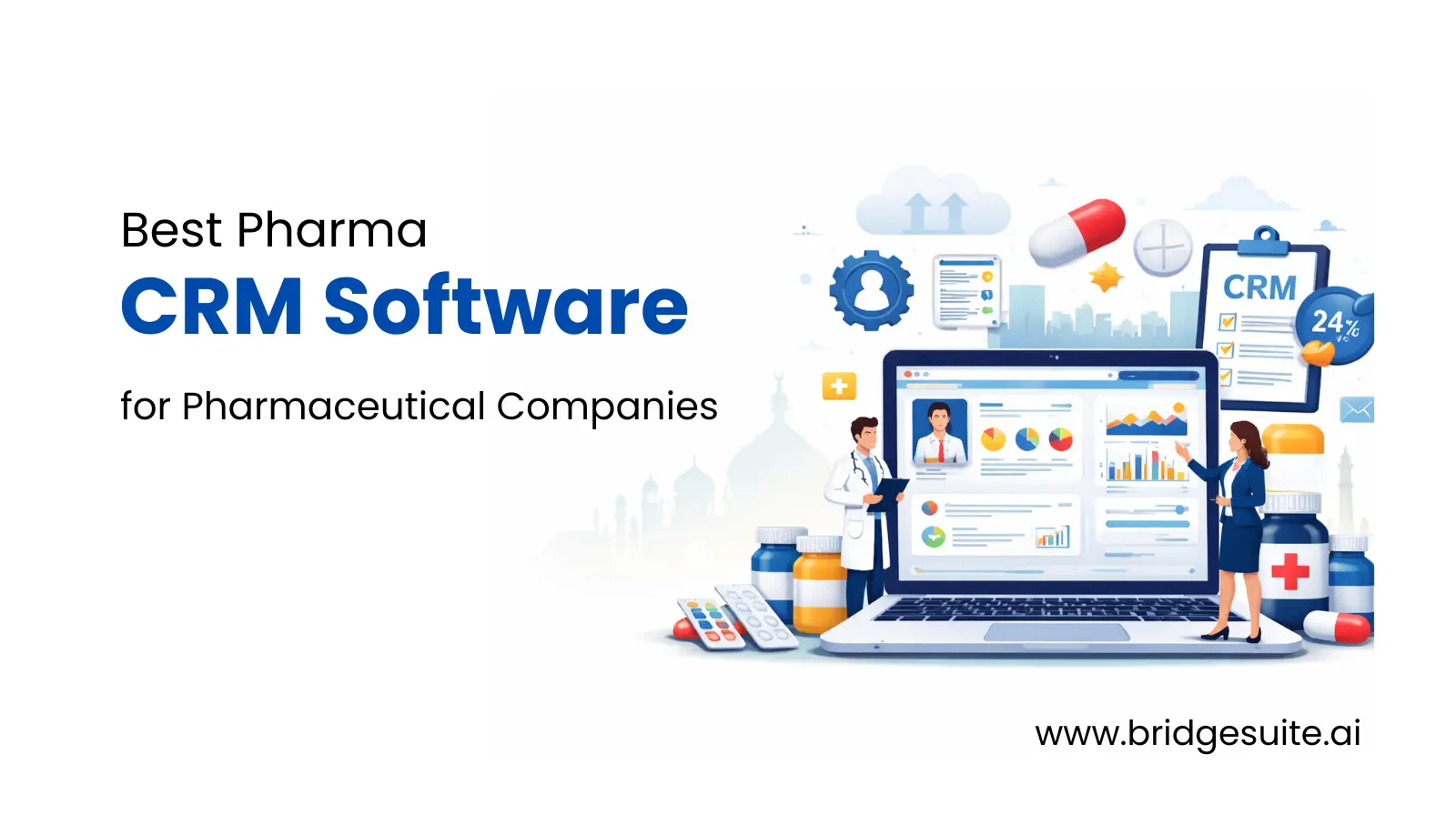
In the year 2026, the Indian pharma industry is valued at over $65 billion, yet there is evidence from market analyses that approximately 40% of the total sales opportunity is lost through ineffective communication between MRs and doctors, and poor management of sales territories.
One reason that comes up is that healthcare representatives may have to manage up to 15-18 face-to-face conversations per day in highly congested metropolitan areas; thus, the difference between recording a “closed” prescription or a missed opportunity is often determined by the type of software program that the MR carries on his/her device.
When deciding on the best pharma CRM software for pharmaceutical companies in India, the decision should not be limited to simply digitizing an old directory, but also take into consideration all of the unique regulatory and geographical challenges associated with the Indian marketplace.
What Does a Pharmaceutical CRM Actually Do?
In essence, a Pharma CRM is essentially a computerized system designed to facilitate the intricate and highly regulated interactions between life sciences companies and HCPs (Healthcare Professionals), including doctors, pharmacists, and hospital personnel.
While a retail CRM typically handles “buy and sell” transactions, a Pharma type of CRM only tracks the interaction(s) between MRs (Medical Representatives) and their targeted HCPs for scientific engagement/influence purposes. MRs are not able to “sell” a prescription medication to a patient directly, so they use the CRM to document the Scientific Engagement and Influence leading up to an HCP writing a Prescription for that particular medication.
That is why a Pharma CRM tracks the entire “Prescription Path” from the MR to HCP with respect to ensuring that the HCP has the proper Medical Information needed to choose your company’s product over your competitors’ products.
Challenges to Pharma Sales without a CRM System
Drug companies are experiencing problems managing all of their sales activity using poor, outdated approaches and systems.
Blind Spots in the Field – Managers are unable to track and evaluate representative activity on a current basis.
Data or Information Gaps – Markets suffer from not being able to monitor the secondary or tertiary market sales.
Siloed Communication – Representatives have delayed access to important data that would positively impact their productivity and results.
Risks to Compliance – Non-compliance with regulations can result from ineffective management of samples.
Essence of a CRM for Pharma Industries:
Retail pharmaceutical businesses are unique in their use of advanced sales processes (pharma companies being solely retail), i.e., finding targets, i.e., physicians, hospitals, chemists, and pharmacists (i.e., finding stockists). Additionally, the selling profession is difficult in compliance with regulatory requirements. Therefore, you need a specialized pharmaceutical CRM that provides an optimized process for target identification.
CRMs like Bridge improve sales reps’ ability to sell by providing needed information (i.e., field force), making decisions based on accurate data (i.e., data at hand), and providing accurate report generation. A high-performing pharmaceutical CRM integrates tracking leads, scheduling appointments, managing inventory, and generating reports in a single system.
Your field force is connected by a Pharma CRM , which serves as its “Central Nervous System” and allows it to operate daily by:
1. Advanced Territory and Stakeholder Management
It creates thousands of physicians in designated territories. The program does not merely keep physician names and locations; rather, it categorizes them according to their residencies, the volume of patients they see each month, and the potential for them to prescribe your products.
— What product was discussed?
— What samples (or “LBLs”) were left behind at the time of the visit?
— The doctor’s feedback/concerns related to the products discussed.
2. Automated Daily Call Reporting (DCR)
MRs used to spend hours completing manual DCR at the end of each day. Fortunately, a Pharma CRM provides an MR with the ability to complete the process upon leaving a doctor’s office. Once the MR has left the office, he/she uses the mobile application to input everything needed to document the visit:
3. Closed-Loop Marketing (CLM)
This is simply a digital form of detailing. Rather than the paper folders used for detailing previously, the representative can show a Highly Interactive presentation on an iPad (or similar device). The Pharma CRM captures how long the doctor viewed each slide (e.g., each slide in a Clinical Trial).
4. Inventory and Sample Tracking
The Pharma CRM assists with tracking and monitoring drug samples in light of the stringent regulations placed upon you by various regulatory bodies. The Pharma CRM will track the batch numbers assigned to each sample provided to the physician in order to prevent the distribution of expired medication and keep the pharmaceutical company compliant with the UCPMP.
Top Features to Look for in Pharma CRM Platforms
Automation of Medical, Legal and Regulatory Compliance: All shared content must pass through integrated ‘Medical, Legal and Regulatory’ compliance workflows for pre-approval prior to communicating with any of our HCP’s to minimize the risk of HCPs being communicated with in a non-compliant manner.
Field Rep Interaction Summary and Clinical Report Auto-Drafting: Field Reps can leverage AI Agents to auto-generate Interaction Summaries and Clinical Reports to significantly reduce the Administrative Burden to the field rep while ensuring the Technical Accuracy of the agreed upon result will still be achieved.
HCP Master Data Management (MDM): A centralized golden record for HCPs prevents duplicate records and ensures that every department in the organization, such as Sales and Medical Affairs, has one truthful view of each doctor and every healthcare institution.
Digital Drug Sample & Signature Tracking: The digital logging of drug sample requests and distributions is automated and allows for the use of built in compliant signatures for audit readiness.
Omni-channel Journey Orchestration: The platform provides a sequencing of interactions across electronic mail, web-seminars, and in-person prospect visits to create a seamless flow of information that does not historically repeat previously engaged content for any particular HCP.
Predictive Prescription Analytics: Machine Learning models analyze historical prescription behavior and geographical data to predict future prescribing trends, allowing for more efficient territory assignments and resource allocations for managers.
ERP & Third Party Integration: Integrated system connectivity directly to back-end ERP & Supply Chain systems allows for real-time visibility and traceability of product to the supply distributed across locations.
Investing in the Right Pharma CRM: Bridge CRM is Here
Now that we’ve gone digital, your platform choice involves more complex considerations than just getting a directory into a digital format. You need to give your team a “Central Nervous System” so they can thrive within a heavily regulated and high-stress environment.
Bridge CRM has been purpose-built for the geographical and regulatory uniqueness of the Indian pharmaceutical industry. Integrated with territory management, Bridge’s real-time, automated reporting enables your Medical Reps to spend less time on administrative tasks and more time on high-value, scientific engagement.
So whether you’re building a national company or simply in need of affordable pharma CRM solutions that are appropriate for small pharma companies, Bridge is an extremely usable, cloud-native ecosystem that can grow with you.
It converts every manual step of the “Prescription Path” into an efficient, data-driven process and makes sure that all activity has been both compliant and well documented from the first outreach to the final delivery of samples while enabling you to utilize the knowledge gained to improve future growth.


0 Comments